Understanding Car Paint Categories in Cyprus: What A to E Means for Your Repair Cost
13 Απριλίου 2026
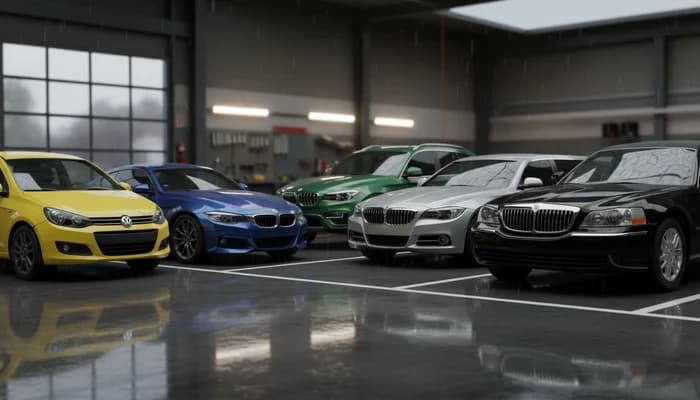
Car paint categories (A through E) classify vehicles by size and paint complexity, and they directly determine your repair cost. Category A covers small cars with standard paint, while Category E covers luxury vehicles with multi-stage finishes. Here is how the system works, what category your car falls into, and how to find your colour code for an accurate quote.
What Are Car Paint Categories and Why Do They Exist?
Paint categories are a standardised classification system used by body shops across Cyprus and Europe to estimate the cost of painting a vehicle. The category reflects two main factors: the physical size of the car's panels (larger panels require more paint material and booth time) and the complexity of the paint system (metallic, pearl, and multi-coat finishes require additional layers and specialised techniques).
Without a category system, every quote would require a full vehicle inspection before any price could be given. Categories allow shops and customers to communicate a ballpark cost range quickly. At Pinelaki, we use the five-tier A to E system that covers every vehicle on Cyprus roads.
What Does Each Category Include?
| Category | Vehicle Type | Examples | Paint Complexity |
|---|---|---|---|
| A - Small | Small hatchbacks, city cars | Toyota Yaris, VW Polo, Fiat 500, Suzuki Swift | Standard solid or metallic |
| B - Medium | Sedans, compact SUVs | Toyota Corolla, VW Golf, Mazda 3, Nissan Qashqai | Standard solid or metallic |
| C - Large/SUV | Large sedans, mid-size SUVs, vans | Toyota RAV4, BMW 3 Series, Mercedes C-Class, Ford Transit | Metallic or pearl |
| D - Premium | Premium sedans, large SUVs | BMW 5 Series, Mercedes E-Class, Audi Q7, Range Rover Sport | Complex metallic, tri-coat, or pearl |
| E - Luxury | Luxury cars, supercars, exotic vehicles | Mercedes S-Class, Porsche 911, Bentley, Ferrari, Lamborghini | Multi-stage, custom, or matte finishes |
Why Do Premium Cars Cost More to Paint?
The price difference between categories is not arbitrary. It reflects real differences in materials, labour, and process complexity.
Panel size: A door panel on a Range Rover Sport is nearly twice the surface area of a door on a Fiat 500. More material is needed, and the spray technique must cover a larger area with consistent thickness and finish.
Paint chemistry: Standard solid colours (plain white, plain black) are single-stage products. The colour and protection are combined in one layer. Metallic paints require a separate base coat with aluminium flakes plus a clear coat. Pearl paints use ceramic mica particles that refract light and require extremely precise application angles. Tri-coat systems (common on premium brands) involve a base colour, a mid-coat pearl or candy layer, and a final clear coat, three separate application stages that each require drying time and quality checks.
Clear coat specifications: Luxury manufacturers often specify high-solid or ceramic-infused clear coats that provide superior UV and scratch resistance. These products cost more per litre and require specific spray gun settings and curing temperatures.
Blending requirements: On a small car, a resprayed panel is close to the adjacent panels, making blending straightforward. On a large SUV or luxury sedan, the repaired panel may be far from the reference surfaces, and the metallic flake orientation must be maintained across a much larger transition zone.
How Do You Find Your Car's Colour Code?
Your colour code is essential for an accurate repair quote. It tells the body shop exactly which paint formula to mix, which is especially important for metallic and pearl finishes that have multiple factory variants under the same colour name.
For most cars, the colour code is printed on a sticker or plate in the driver-side door jamb. Open the driver's door and look at the pillar where the door latches. You will see a label with the manufacturer's logo and several codes. The paint code is usually a three-digit or alphanumeric code, often labelled "C/TR" (colour/trim) on Japanese cars or simply printed near the VIN on European vehicles.
If you cannot find the code on the door jamb, check under the bonnet near the firewall, inside the boot lid, or in the glovebox. Each manufacturer has a preferred location. You can also call your dealer with your VIN and they will provide the factory colour code.
Once you have your code, you can use our free online estimator to get an instant price range based on your vehicle's category and the repair needed.
Does the Category Affect Repair Time?
Yes. A Category A vehicle with a single solid-colour panel can often be completed in one to two days. A Category E vehicle with a tri-coat pearl finish on a large panel may require four to five days due to multiple application stages, longer curing times between coats, and the additional blending and quality-check steps.
At Pinelaki, we provide an estimated completion date at the time of booking so you can plan accordingly. We also offer courtesy transport assistance if your repair will take longer than two days.
Can a Category C Car Have a Category D Price?
Occasionally, yes. The category is determined by both size and paint type. A mid-size SUV like a Hyundai Tucson normally falls into Category C, but if it has been factory-painted in a special-edition pearl or matte finish, the paint complexity bumps it to Category D pricing. Conversely, a large premium sedan with a simple solid colour might be quoted at a lower rate than a smaller car with a complex tri-coat finish.
This is why we always ask for the colour code in addition to the make and model. The code tells us the exact paint system, and the exact paint system determines the true cost.
How Do You Get an Accurate Quote for Your Car?
The fastest way to get a precise repair estimate is to visit our AI Damage Estimator. Upload a photo of the damage, enter your make, model, and colour code, and receive an instant estimate based on your vehicle's category. For complex cases or if you prefer to speak with a technician, call us directly at +357 99228438 or visit our Nicosia workshop at Mesokeleos 15, Pallouriotissa 1042.